

Written and Verified by:

Dr. Pratyush Ranjan
MBBS, DOMS, DNB & MAMS
Published On: 3 Months
Table of Contents:
Fellowship Announcement
Program Overview
Eligibility Criteria
NMC Temporary Registration
Application Process
Benefits and Support
Important Notes
Short-Term Fellowship in Cataract and Refractive Surgery at Varanasi
Varanasi is the oldest continuously inhabited city in the world and is the place where the first documented cataract surgery was performed around 600 BC by the legendary surgeon Sushruta, often hailed as the father of Indian surgery and ophthalmology.
In his seminal text, the Sushruta Samhita, he detailed innovative techniques like “couching,” where a specialized lancet was used to displace the clouded lens into the vitreous cavity, restoring vision to patients without removing the lens entirely a remarkably advanced extracapsular method for its time.
He described 76 eye conditions, 51 of which required surgical intervention, and emphasized holistic training, including anatomy dissections on cadavers and ethical patient care. Students from far and wide flocked to learn from him, carrying this pioneering knowledge to Southeast Asia, China, the Middle East, and beyond, influencing global ophthalmic practices for millennia.
99
Share
Fellowship Announcement
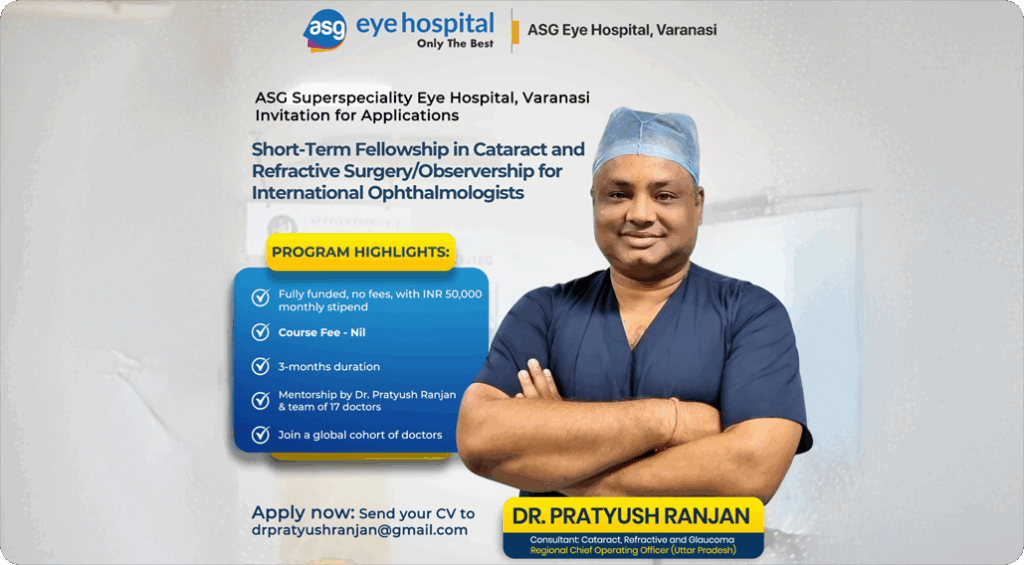
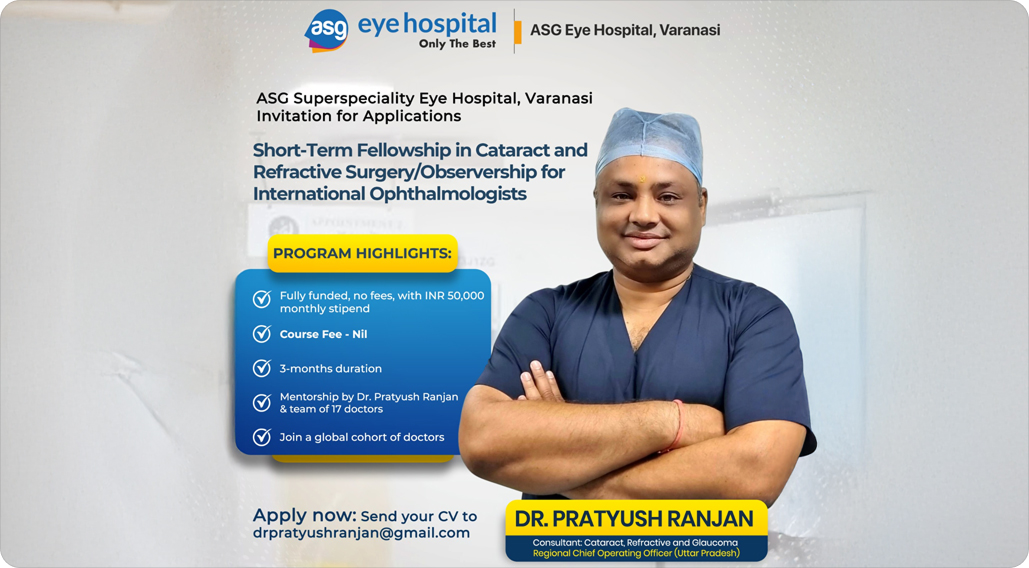
ASG Super Speciality Eye Hospital, Varanasi is pleased to announce a comprehensive 3-month Short-Term Fellowship Program in Cataract and Refractive Surgery.
This intensive hands-on training is designed for qualified ophthalmologists seeking to enhance their surgical skills and expertise in advanced cataract procedures and refractive techniques.
Under the guidance of renowned mentor Dr. Pratyush Ranjan, fellows will gain practical experience in a high-volume clinical setting, focusing on cutting-edge surgical methods and patient management.
Program Overview
- Duration: 3 months (full-time commitment required).
- Venue: ASG Super Speciality Eye Hospital, Varanasi, India – a state-of-the-art facility equipped with modern ophthalmic technology, including advanced phacoemulsification systems, femtosecond lasers, and diagnostic tools for refractive surgery.
- Mentor: Dr. Pratyush Ranjan, a distinguished ophthalmologist with extensive experience in cataract and refractive surgery. Dr. Ranjan has performed thousands of successful procedures and is committed to mentoring the next generation of eye care specialists through personalized training and case discussions. (For more information, visit https://asgeyehospital.com/doctor/dr-pratyush-ranjan.)
- Focus Areas:
Oversimplification and premium IOL implantation.
Refractive procedures such as LASIK, PRK, SMILE, and ICL implantation.
Posterior capsular complications and subluxated lenses.
Preoperative assessment, postoperative care, and complication management.
Surgical planning and follow-up clinics.
Eligibility Criteria
- Surgeon’s Fee: This is often the largest portion of the total cost. Surgeons with more experience or those working in high-demand areas may charge higher fees. Expect to pay between 1,500 and 3,000 for the surgeon’s services.
- Anesthesia Fees: Depending on the type of anesthesia used, this can add another 500 to 1,000 to your total bill. General anesthesia tends to be more expensive than local anesthesia.
- Facility Fees: The cost of using the surgical facility also varies. If the surgery is done in a hospital, the fees may be higher compared to an outpatient surgical center. Facility costs can range from 1,000 to 2,000.
- Pre-operative and Post-Operative Care: These include consultations, follow-up visits, and any necessary medications. Budget for about 200 to 500 for these expenses.
- Miscellaneous Costs: This can include costs for diagnostic tests, eyeglasses, or additional treatments. It’s wise to set aside an additional 300 to 600 for these potential expenses.
Process for Temporary Registration with NMC
When you combine all these factors, the total cost can range from 30,000 TO 75,000 per eye. It’s essential to ask for a detailed breakdown of these costs from your healthcare provider to understand what you’ll be responsible for.
Application Process
Several factors can impact the total squint eye surgery cost:
- Geographic Location: Prices vary significantly between urban and rural areas. Major metropolitan areas typically have higher costs due to increased demand and living expenses.
- Surgeon’s Expertise: Experienced surgeons or those who specialize in strabismus surgery may charge more, but their expertise can often lead to better outcomes.
- Complexity of the Case: Some cases may require more complex surgical procedures or additional treatments, increasing the overall cost.
- Insurance Coverage: Many insurance plans cover squint eye surgery if it’s deemed medically necessary. However, coverage can vary widely, and it’s crucial to check with your provider for specifics.
Benefits and Support
Before proceeding with surgery, it’s important to check your insurance coverage. Many plans will cover the costs if the surgery is deemed medically necessary, which is often the case in children or severe adult strabismus. Here are a few steps to follow:
- Consult Your Insurance Provider: Contact your insurance company to understand your coverage, including any pre-authorization requirements.
- Get a Letter of Medical Necessity: Your eye doctor may need to provide documentation to justify surgery.
- Check for In-Network Surgeons: If you have a preferred provider organization (PPO) plan, choosing an in-network surgeon can significantly lower out-of-pocket expenses.
Important Notes
Squint eye surgery can be life-changing for those suffering from misaligned eyes. While the squint eye surgery cost may seem daunting, understanding the price components and exploring insurance options can make it more manageable. Always consult a qualified ophthalmologist to discuss your specific needs and to receive an accurate estimate tailored to your situation. With proper planning and research, you can take a significant step towards better vision and enhanced quality of life.
Contact
- Accommodation and Meals: Fellows are responsible for arranging their own stay and food in Varanasi. The hospital can provide recommendations for affordable housing (approx. INR 15,000–25,000/month).
- Visa and Travel: Fellows must handle their own visa applications, travel arrangements, and health insurance. A Medical Visa is typically required.
- Health Requirements: Proof of COVID-19 vaccination and other health clearances may be necessary.
- Attendance: This is a full-time program (Monday–Saturday). No leaves permitted except in emergencies.
- Ethical Standards: All training adheres to the highest ethical and medical standards, with a focus on patient safety and informed consent.
More Fellowship Programs
Home Written and Verified by: Dr. Pratyush Ranjan MBBS, DOMS, DNB & MAMS Published On: 3 Months Table of Contents: Fellowship Announcement Program Overview Eligibility Criteria NMC Temporary Registration Application Process Benefits and Support Important Notes Short-Term Fellowship in Cataract and Refractive Surgery at Varanasi Varanasi is the oldest continuously …
